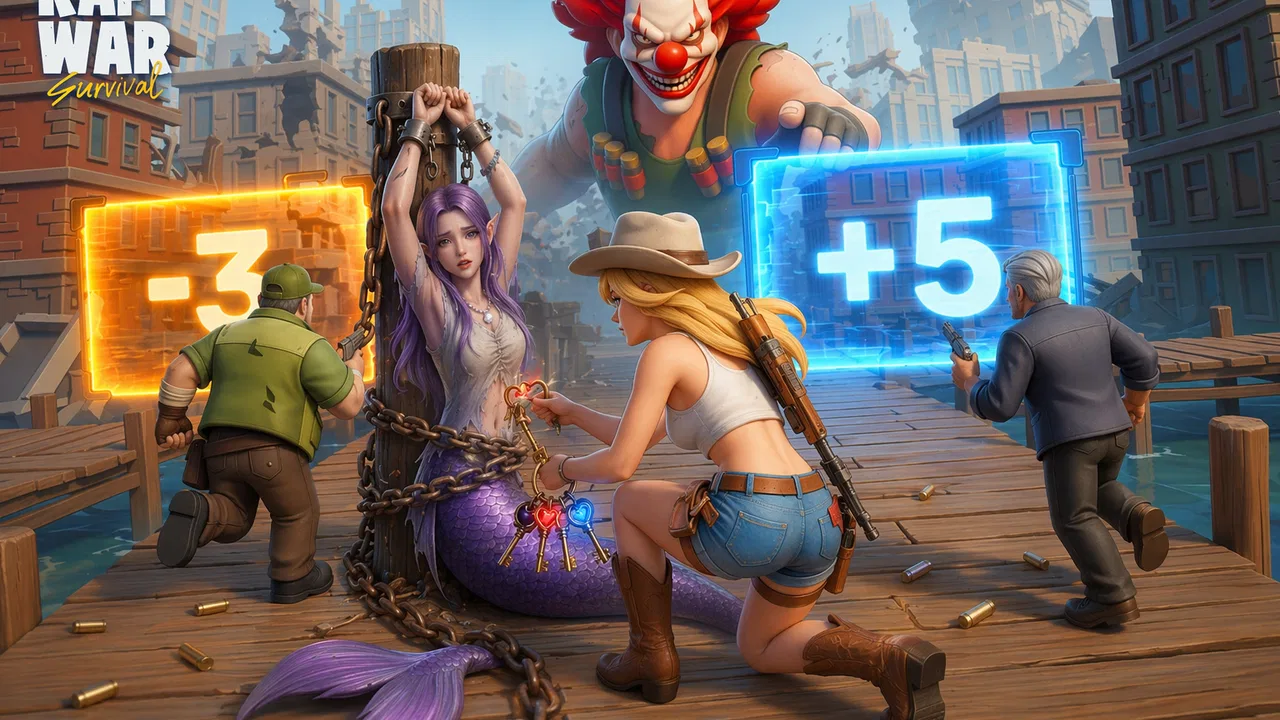
Raft War Survival
- 4.5
- Rating
- 1.00M
- Installs
- Free
- Price

 Analysis by App-foxy
I spent time with Raft War Survival as a mobile simulation game built around a simple question: how well can I grow a small force while trying to take control of the sea? Its premise is easy to understand, but the enjoyable part comes from deciding when to expand, when to protect what I have, and when a risky move is worth making. I found it most appealing in short sessions, especially when I wanted something more active than a traditional idle game but less demanding than a full strategy title.
The game is free to start, and Larks Holding Limited presents it for a Teen audience. It has already passed over a million installs, with a 4.5 average from around eleven thousand ratings and roughly one thousand reviews. Those figures suggest that the basic loop has found an audience, but they do not remove the need to decide whether its style suits you. This is a game about repeated choices and gradual improvement, not a deep naval simulator.
How the decisions shape each run
The central appeal is the relationship between army size and progress. Building up feels useful because a larger force gives me more confidence when facing the next challenge, yet expanding without thinking can make a run feel wasteful. I learned to treat every opportunity as a planning choice rather than automatically taking the biggest visible reward. A short-term increase can be attractive, but the better decision is often the one that leaves me prepared for what follows.
You May Also Like

 Blood Strike: 2.5 Anniversary
Blood Strike’s Loadouts Turn Every Drop Into a Tactical Gamble
A close look at Blood Strike’s custom loadouts: how fast access to signature weapons reshapes its battle royale rhythm, rewards preparation, and narrows the gap between fights.

 Pandora - Music & Podcasts
Pandora’s Music Is Easy to Start, but Harder to Recover
Pandora’s strength is its low-effort path from a seed to a station. Its weak spot is how much confidence it asks you to place in connection, setup, and quiet recovery.

 8 Ball Pool
 Is Built on Rivalries, Rematches, and Routine
A close look at the rivalries, rematches, shared routines, and unanswered safety questions that turn a quick pool match into a persistent mobile community.

 Samsung Music
’s Quiet Strength Is Playing What You Already Own
Its reach comes less from spectacle than from dependable access to a personal library. That simplicity is both the app’s strongest retention engine and its ceiling.

 AccuWeather: Weather Radar
AccuWeather Review: A Quick, Clear Forecast for Everyday Decisions
For everyday plans, the best forecast is the one you can understand quickly. AccuWeather makes rain timing, radar, and local conditions easy to act on, with a few trade-offs.

 Hill Climb Racing
Why Hill Climb Racing Still Turns Crashes Into One More Run
A tiny car, a bumpy hill and one more upgrade: Hill Climb Racing keeps resurfacing because its simple chaos makes every near-miss feel personal.
More From Our News Desk



That makes the game different from a purely automatic progression title. I still get the satisfaction of watching numbers and resources improve, but I am not only waiting for a timer to finish. The sea setting gives those decisions a clear identity: I am not simply upgrading a base in a generic menu; I am trying to move an army forward and maintain enough strength to keep the campaign going.
My most useful habit was to pause mentally before committing to an action. If my force was already in a comfortable position, I could afford to chase a more ambitious choice. If I had just recovered from a difficult encounter, preserving momentum mattered more than squeezing out one extra gain. That small change in attitude made the game feel less random and gave each session a clearer rhythm.
Planning for the next obstacle
The best way to approach a session is to think one step beyond the current screen. I tried not to spend all of my available advantage immediately, because the next encounter may demand a stronger position than the present one. This is a useful lesson for newcomers: progress is not only about making the army bigger right now. It is also about avoiding a situation where a poor decision leaves no room to recover.
That planning horizon is where the simulation label makes sense. The game compresses a larger survival-and-expansion idea into quick decisions, so I am constantly balancing present comfort against future flexibility. It does not ask me to manage a complicated economy, but it does reward restraint and awareness.
One practical use case is a short break during a commute or between daily tasks. I can play a few moments, make a meaningful choice, and stop without needing to remember a large web of systems. On the other hand, anyone expecting a detailed fleet simulator, a broad construction sandbox, or a long-form tactical campaign may find the decision space too narrow.
Risk, reward, and the cost of overconfidence
The strongest moments come when I have to choose between a safe improvement and a tempting gamble. Playing cautiously keeps the run stable, but excessive caution can also slow the feeling of conquest. Taking risks creates the possibility of faster progress, yet a failed decision can make the next part of the session feel like recovery rather than advancement.
I appreciated that tension because it gives ordinary actions a little more weight. A reward is not valuable only because it is large; it is valuable when it arrives at the right time. If I already had enough strength to handle the next stage, a conservative choice could be smarter than chasing something uncertain. If I was falling behind, a calculated risk might be necessary.
The important trade-off is not speed versus slowness; it is momentum versus stability. Players who always push forward may enjoy exciting swings but lose consistency. Players who protect every advantage may rarely fail but can make the game feel flat. I found the best rhythm by changing approach according to the state of the run rather than following one fixed rule.
This also affects how the game feels over repeated sessions. A strong result does not always come from the boldest move. Sometimes the satisfying outcome is finishing with enough strength to continue comfortably, because that means earlier decisions worked together. The game is at its best when I treat each choice as part of a chain instead of judging it in isolation.
Where the free model enters the experience
Raft War Survival is free, but it includes in-app purchases ranging from $0.99 to $99.99 per item. That range is important for anyone who prefers games with no spending pressure. I could approach the core experience without paying, but players who are sensitive to optional purchases should decide in advance whether they are comfortable with that structure.
My advice is to set a personal rule before playing: either enjoy the normal pace or choose a small, deliberate budget rather than making an impulse purchase after a disappointing run. This is especially useful in a game built around recovering from setbacks, because frustration can make a shortcut seem more valuable than it really is.
The trade-off is straightforward. Spending may make progress feel more convenient, while refusing to spend asks for more patience and better decisions. For me, the free entry point is enough to judge whether the loop is enjoyable. I would not recommend paying simply to discover whether the basic style suits you.
Adapting instead of repeating one formula
A common mistake is to find one successful pattern and use it forever. I initially leaned toward repeating the safest option, but that approach became less satisfying when the situation changed. The better method was to reassess the condition of my army, the value of the available opportunity, and how much room I had for a setback.
This is where the game offers more thought than its short description suggests. The challenge is not just accumulating power; it is recognizing when accumulated power should be spent. A large force that never takes a meaningful risk is not necessarily helping me progress efficiently. Conversely, a smaller force can still move forward if I choose carefully and avoid unnecessary losses.
I also found that session length changes the right strategy. In a very short session, I preferred reliable progress because I might stop before recovering from a failed gamble. During a longer session, I was more willing to test aggressive choices and accept temporary setbacks. That makes the game suitable for different moods, although it does not transform into a completely different genre when played for longer.
Who will enjoy this approach?
I would recommend it to players who like light strategy, incremental growth, and sea-themed survival framing without wanting a complicated control scheme. It works well for someone who enjoys checking progress, making quick choices, and learning from a run that did not go as planned.
It is also a reasonable choice for a casual player who wants something more interactive than a passive number-go-up game. The army-and-conquest idea gives each improvement a visible purpose, and the survival angle makes failure feel connected to planning rather than merely waiting.
I would skip it if you want precise tactical battles, extensive customization, competitive multiplayer, or a realistic naval model. I would also look elsewhere if optional purchases make free-to-play progression immediately irritating. A conventional strategy game may be better for players who want a large map, layered diplomacy, or long-term base management. A pure idle game may be better for someone who wants almost no decisions at all.
What changes after the first few sessions
The first sessions are mainly about understanding the loop and learning not to waste opportunities. After that, the novelty depends on whether you enjoy refining decisions. I began asking more useful questions: Am I building enough reserve for the next obstacle? Is this reward helping future progress or only improving the current moment? Would a safer choice leave me in a better position if the next step is unfavorable?
Those questions create a modest but real layer of depth. The game does not need a large rulebook to make planning matter. Its depth comes from the interaction between limited confidence, growing ambition, and the possibility that an apparently good choice may be poorly timed.
Still, the limits are clear. The experience is streamlined, so players looking for a constantly expanding strategic vocabulary may eventually want something more substantial. I could make better decisions over time, but I was not learning an enormous system with dozens of independent mechanics. That is a strength for accessibility and a weakness for long-term strategists.
The current version is 0.18.0, and the game was released on July 14, 2025. Those details place it in a relatively early stage of its life, so I would judge it primarily by the loop available now rather than by assumptions about future additions. On Android, it requires version 7.0 or later, which makes it accessible to many older compatible devices.
Small habits that improve the experience
Before choosing a reward, consider whether it improves immediate power or protects the next decision. The second option is often more valuable when the run is already unstable.
Do not treat every setback as a reason to spend. First identify whether the problem came from bad timing, excessive risk, or insufficient preparation.
Use short sessions to test conservative choices and longer sessions to explore riskier routes. This keeps a failed experiment from feeling like it consumed an entire play period.
When progress feels repetitive, change your decision rule rather than simply playing faster. A different balance between reserve and aggression can make the same loop more engaging.
These habits do not turn the game into a complex strategy simulator, but they help reveal what is genuinely enjoyable about it. I found that the experience improved when I stopped chasing the largest immediate gain and started valuing the position it created for the following stage.
My strategy verdict
Raft War Survival works because it keeps its objective understandable while leaving room for judgment. I liked the feeling of growing an army and trying to carry that advantage across the sea, especially when a safe decision competed with a potentially stronger one. The game is easy to pick up, free to begin, and well suited to short bursts of play.
Its weaknesses come from the same simplicity. The decision space is focused rather than broad, and players who need detailed battles or a deep management system may run out of interest. The purchase range also means that people who dislike free-to-play structures should approach carefully and decide their spending boundaries before they get invested.
For me, the best reason to try it is not the promise of endless complexity. It is the compact loop of building strength, judging risk, and adapting when the obvious choice is not the best one. If that sounds like the kind of lightweight strategy you enjoy, I think it is worth installing and testing without spending money first. If you want a full naval simulation or a demanding strategy campaign, this is probably not the right destination.
Overall, I see it as a focused mobile simulation game for players who enjoy planning in small doses. Larks Holding Limited has shaped the experience around momentum and survival rather than realism, and that gives it a clear identity. I would recommend it to a friend who wants quick sessions with a little more thought than a routine idle game, while being honest that its long-term appeal depends on how much pleasure they get from refining the same core decisions.
FAQs for Raft War Survival
01What is Raft War Survival about?
Raft War Survival is a survival-focused game in which you must stay alive on a raft while dealing with dangerous environments, limited resources, and hostile threats. Gameplay generally combines exploration, resource collection, crafting, and defensive decisions. Before downloading, keep in mind that progress depends on managing supplies carefully and learning how the game’s survival systems work.
02Can Raft War Survival be played offline?
The availability of offline play may depend on the specific version and features included by the developer. Core survival gameplay may work without a constant connection, but advertisements, cloud saving, updates, rewards, or other online services can require internet access. It is best to check the store listing and test the game after installation if offline access is important to you.
03Is Raft War Survival free to download and play?
Raft War Survival can generally be downloaded without an upfront purchase, but free access does not always mean that every feature is completely free. The game may include advertising, optional in-app purchases, rewarded videos, or items that speed up progress. Parents should review purchase settings, while all players should check the payment information shown on their device before confirming transactions.
04What devices are compatible with Raft War Survival?
Compatibility depends on the operating system, device model, available storage, and the minimum software version required by the developer. Older phones or tablets may experience slower performance, longer loading times, or reduced visual quality. Before downloading, review the official Google Play or App Store requirements and make sure your device has enough free space for the installation and future updates.
05Does Raft War Survival require a lot of time or offer multiplayer?
The game is mainly suited to players who enjoy repeated survival sessions, gathering materials, improving equipment, and gradually making progress. Some sessions can be short, but advancing may require regular attention to resources and threats. Multiplayer availability can vary by version, so do not assume that online cooperation or competitive features are included unless they are clearly listed on the official store page.
Pros
- Simple controls make the game easy to pick up on mobile.
- Survival gameplay offers a satisfying challenge for short sessions.
- Resource gathering adds purpose to exploration and progression.
- Raft customization lets players improve their floating base.
- Offline play may be convenient when no internet connection is available.
Cons
- Progress can feel repetitive after extended play sessions.
- Limited character and raft variety may reduce long-term appeal.
- Some features may be restricted behind ads or in-app purchases.
- Touch controls can feel imprecise during hectic survival moments.
- Device performance may drop in larger areas or busy scenes.

Raft War Survival
Gallery